Chapter 5: Conclusion
Chapter 5: Conclusion
Synthesis of case study findings across all three sub-questions. Challenges state takeovers as extensions of the unconstitutional system. Applies a critical epistemological lens to the STAAR-based accountability architecture. Proposes ARC-based funding recalibration using student-level PEIMS data. Orients toward the 90th Legislature (2027).
4F. Reflections and Shortcomings (merged into Conclusion)
Surprising Results
The ARC regression produced three unexpected findings. The high school dropout model (R² = 0.45) generated a wrong-sign coefficient for economic disadvantage (β* = -0.034, n.s.), meaning campuses with higher poverty appeared to have lower dropout rates after controlling for other factors. The explanation is that 37.4% of campuses reported zero dropouts due to FERPA masking of counts below 5, inflating the sample with artificial zeros. The dropout model was rejected in favor of the chronic absenteeism model, which produced consistent, expected-sign coefficients across all three school levels.
The 46.1% zero-designation rate at Q4 campuses in the TIA analysis was unexpected. TIA's socioeconomic tier multiplier was designed to direct more funding to high-poverty campuses. The multiplier applies to per-teacher allotments. Campuses serving the highest-need students produce fewer designated teachers per student, generating smaller total allotments despite the multiplier. Participation without commensurate designation is not vertical equity.
The three-day ILTexas charter amendment timeline was unexpected. Standard charter amendments require public notice, community input, and TEA review spanning months to years. SB 2 (2013) transferred approval authority from the elected State Board of Education to the appointed Commissioner, removing the procedural guardrails that would have allowed Cleveland ISD stakeholders to participate in the decision.
The simultaneous contraction of both Austin ISD and KIPP Texas contradicted the market-competition theory underlying charter expansion policy. Austin ISD announced the closure of 10 schools in November 2025 while KIPP closed 5 Austin campuses in December 2025. Both face the same structural pressures of declining birth rates, rising housing costs, and a 45% kindergarten capture rate (Austin ISD, 2024). The zero-sum transfer predicted by market theory did not occur.
First-Person Accounts
Kevin Hopper currently serves as Project Supervisor in Austin ISD's Project HELP, which administers McKinney-Vento homeless services and foster care educational liaison services. The data in this capstone, the PEIMS at-risk percentages, the foster care counts masked by FERPA, the chronic absenteeism rates, correspond to students Hopper works with directly. A campus with 15% homelessness is not a demographic statistic; it is a caseload of families without stable addresses who need shelter coordination, immunization compliance, and transportation across attendance zone boundaries. Hopper previously worked as a homebound teacher in Austin ISD.
Before Austin, Hopper worked in Dallas ISD under the Teacher Excellence Initiative. He worked at the same school as Kristen DeRocha, who conducted the statistical analysis showing the salary gap between choice and comprehensive campuses (DeRocha, 2019). DeRocha shared her analysis with Hopper, and together they turned it into a public campaign through Alliance-AFT's social media presence. Dallas ISD would not acknowledge that TEI's evaluation structure was inequitable because TEI had become the basis for TIA under HB 3 (2019). DeRocha's data proved the inequity, and the campaign forced Dallas ISD to implement separate evaluation distributions for choice and comprehensive campuses in 2020-21 (Dallas ISD, The Hub, 2020). When HB 3 established TIA at the state level, it replicated the original TEI design without that equity correction. Hopper's direct experience with the TEI system and its reform informed the development of the ARC framework to quantify the cumulative risk that flat funding weights and incentive programs fail to address.
Shortcomings and Limitations
FERPA masking limits the ARC model's precision at small campuses. TEA suppresses student counts below 5, which introduces systematic bias: 50.9% of foster care values, 40.9% of homeless values, and 82.6% of pregnancy/parenting values are masked statewide. Masked values are treated as zero, biasing ARC scores downward. The Austin ISD unmasked validation demonstrates the magnitude of this bias: R² increases of 0.28 to 0.57 across school levels.
Charter school financial data is less standardized than ISD data. ILTexas campus-level expenditures could not be isolated from the system-wide financial reporting without PIR requests. The ILTexas campus-level staffing, construction, and bond data in this capstone was obtained through 3 PIR requests filed between February and March 2026. Standard PEIMS financial reporting does not disaggregate charter expenditures to the campus level with the same granularity available for ISDs.
The scope of this capstone, four sub-questions across four metropolitan areas with a statewide regression model, is ambitious for a single researcher. A full-scale study would include multi-year panel data, district-level interviews, and legislative fiscal note analysis. The public information request data pipeline remains active, with responses still incoming as of April 2026.
How Results Compare to Hypothesis
The main research question asked whether the current Texas school finance system meets the constitutional standard of an "efficient system" under Article VII, Section 1 as defined through Edgewood I (1989) and Morath (2016). The evidence across all four sub-questions strongly suggests it does not. The TIA policy pipeline (SQ1) concentrates incentive resources in already-advantaged campuses through a design flaw the originating district identified and corrected. Charter/ISD duplication (SQ2) produces two collapsing school networks in the same geography with duplicated governance, stranded costs, and demographic sorting. The bond election mechanism (SQ3) systematically locks out high-poverty communities from facility funding. The frozen compensatory weight (SQ4) understates cumulative risk by a factor of 2 to 3, generating a $1.82 billion statewide funding gap. Each sub-question addresses a different structural component. Together, they document a system that fails the efficiency, suitability, and adequacy standards the Morath court established.
5.1 Answering the Research Questions
The central research question asked whether the current Texas school finance system, as expanded to include charter school funding and facility funding dependent on local bond elections, meets the constitutional standard of an "efficient system" of public free schools as defined through Edgewood v. Kirby (1989) and Morath v. The Texas Taxpayer and Student Fairness Coalition (2016). The evidence across four sub-questions answers this question.
Sub-question 1 traced TIA's origin to Dallas ISD's Teacher Excellence Initiative (TEI), created in 2012 under governance installed through PAC-funded board campaigns. DeRocha (2019) documented a salary gap between selective-admission campuses and neighborhood schools that grew from $2,394 in 2016-17 to $11,500 by 2019-20. Dallas ISD corrected the gap in 2020-21 by creating separate evaluation distributions. TIA, modeled on the pre-correction TEI, carries no campus-type adjustment. Statewide, 46.1% of Q4 (highest-need) campuses have zero TIA-designated teachers. The socioeconomic tier multipliers increase per-teacher funding at high-need campuses, but the bell-curve evaluation structure limits the number of designated teachers those campuses can produce.
Sub-question 2 documented a "dual collapse" in Austin, where Austin ISD lost approximately 2,600 students between 2020-21 and 2024-25, and KIPP Texas closed five Austin campuses in December 2025. Both systems face the same structural pressures of declining births, housing costs, and a 45% kindergarten capture rate. Only the ISD bears the full fixed-cost burden of voter-approved bond debt. Charter expansion did not produce the competitive improvements free market ideologues predicted. Instead, it produced parallel systems, both underfunded, serving overlapping populations with demographic sorting. Charter networks serve lower concentrations of at-risk students than ISD campuses in their geographic overlap zones. KIPP Texas's 40% annual teacher turnover, more than double Austin ISD's 17.7%, indicates structural instability rather than instructional excellence.
Sub-question 3 showed that Cleveland ISD failed four of five bond elections since 2019, securing $198 million of $838 million sought. Ten Texas districts have failed every non-athletic bond proposition since 2016: 39 propositions, zero passes. The state's response to Cleveland's bond failures was to fast-track ILTexas into the same service area on a three-day timeline, authorizing 7,000 charter seats funded through revenue bonds requiring no voter approval. ILTexas received $107.9 million in facility capacity while $640 million in Cleveland bond authorization was rejected by voters across four failed cycles 2019-2023. Forney ISD, Princeton ISD, Liberty Hill ISD, and Hutto ISD, with comparable enrollment growth of 15% to 40%, passed 15 of 15 non-athletic bond propositions across 8 elections during the same 2019-2023 period. Their property values per student range from $350,000 to $550,000. Cleveland ISD's is approximately $180,000.
Sub-question 4 showed that the frozen compensatory weight of 0.20 underestimates the actual cost burden of serving students with co-occurring risk factors by a factor of two to three. The ARC regression models (R² = 0.40 for elementary, R² = 0.46 for middle, R² = 0.32 for high school chronic absenteeism) produce empirically derived weights from 2023-24 PEIMS data across 8,674 campuses. The statewide funding gap between the frozen statutory allotment and the regression-derived allotment totals $1.82 billion.
5.2 State Takeover as Constitutional Violation
The four sub-questions document a school finance system with structural deficiencies. The state takeover mechanism under TEC Chapter 39A converts those deficiencies into a self-reinforcing cycle. The system underfunds ISDs serving high concentrations of at-risk students ($1.82 billion gap from frozen weights). Charter schools expand into those service areas, drawing enrollment and per-pupil funding without any requirement to assess the impact on the affected district (19 TAC 100.1035 contains no ISD impact assessment). As ISDs lose enrollment, per-pupil fixed costs rise. STAAR-based accountability ratings decline as the student body's socioeconomic composition shifts. The ISD triggers a TEC Chapter 39A intervention. TEA replaces the locally elected board.
Houston ISD is the proof case. Commissioner Morath appointed Mike Miles as superintendent in June 2023 under TEC Chapter 39A. Miles implemented NES turnaround stipends of $10,000 per year. Within one year, 4,700 of 11,000 teachers (approximately 43%) left the district (Houston Public Media, 2023). NES stipends fell from $10,000 in 2023-24 to $4,000 by 2025-26 (KHOU, 2025; Houston Public Media, 2025). Enrollment declined by approximately 7,400 students in 2024-25 (Houston Public Media, 2024). Fort Worth ISD entered state takeover in October 2025 (Texas Tribune, 2025) and deployed the same model at six campuses with advertised $100,000 teacher salaries that the bell-curve evaluation structure makes statistically improbable for most teachers to achieve (Fort Worth Report, 2026). Dallas ISD under Miles (2012-2015) saw teacher turnover jump from 12% to 22% (WFAA; Texas Tribune, 2023). Three major Texas districts have now experienced the same cycle: governance change, deployment of the Dallas model, mass teacher turnover, enrollment decline.
Under the Morath court's "suitability" prong, the system must be "structurally sound." A system that underfunds ISDs, enables charter expansion that drains enrollment, uses the resulting accountability failures to trigger state takeover, and deploys a compensation model that structurally stagnates wages while producing temporary test score gains is not structurally sound.
5.3 Scientism: The Epistemological Failure
STAAR scores serve as the metric for TEI teacher evaluations (35% of the composite score), TIA designation decisions, campus accountability ratings, and the TEC Chapter 39A triggers that authorize state takeover. A single testing instrument determines teacher compensation, school reputation, district governance, and the allocation of billions of dollars in public funding.
The ARC regression models show that campus-level outcomes are predicted by demographic composition The factors defined by the state's own statutory criteria under TEC Section 29.081 account for 32% to 46% of the variance in chronic absenteeism outcomes across the three grade-level models. When the student population is controlled for, the "school effect" that accountability ratings claim to measure largely disappears.
Dallas ISD's ACE program produced test score gains that disappeared when stipends were cut (Morgan et al., 2023). NAEP scores for Dallas ISD showed "statistically significant declines" in fourth-grade reading across every testing cycle since TEI implementation began (Betzen, 2019). Ector College Prep in Odessa improved from an F to a B accountability rating during its Third Future Schools contract, then slid back to a D after the partnership ended (WFAA, 2026). The measurement of test scores presents itself as neutral, but the consequences it triggers (salary penalties for teachers at high-poverty campuses, accountability sanctions for high-poverty districts, state takeover of the poorest-performing systems) are punitive of the conditions the schools serve rather than the quality of the education they provide.
Foucault's (1977) analysis of power and knowledge offers a framework for evaluating the seemingly neutral power structure of the testing regime and whose interests it ultimately serves. Todd Williams chaired the commission that recommended TIA (2018). His organization, Commit Partnership, manages TIA implementation statewide with $34 million in annual revenue. The PACs connected to Williams (Dallas Kids First, EducateDallas) funded the board campaigns that installed the governance that created TEI. Miguel Solis serves as Commit's president while sitting on the boards of both PACs. The metric, the policy, the governance, and the revenue flow form a closed system traceable to specific individuals, organizations, and funding sources documented in Texas Ethics Commission filings and IRS 990 returns. The system also serves real estate interests. Tax-rate compression under HB 3 (2019) reduced school property tax rates, increasing property values and developer margins, while weakening recapture. Charter school expansion absorbs enrollment growth without requiring voter-approved bonds, eliminating a potential tax increase that would reduce property competitiveness.
5.4 From Frozen Weights to Student-Level Funding
The compensatory weight of 0.20 and the bilingual weight of 0.10 came from the 1985-86 Accountable Costs Study, which collected data through paper questionnaires mailed to districts asking for self-reported expenditures by program area. Many districts wrote "N/A" where program-level breakdowns were unavailable (Texas Education Agency, 1986). The committee recommended raising the bilingual weight to 0.26. The Legislature never enacted the increase.
TEA now operates PEIMS, a mandatory annual reporting system collecting student-level data from all 1,200 districts and 9,600 campuses. PEIMS tracks individual student demographics, program participation across the TEC Section 29.081 at-risk criteria, attendance records, disciplinary actions, and mobility. The data needed to recalibrate funding weights is already in TEA's possession.
The ARC framework demonstrates proof of concept through the use of publicly available PEIMS and TAPR data from 2023-24 to derive empirically grounded weights for each at-risk factor. The methodology uses OLS regression with campus-level risk factor proportions as predictors and chronic absenteeism as the dependent variable. The resulting weights can be recalculated annually as demographics shift, and ARC scores could even be calculated down to the student level with unmasked data. This approach operationalizes IDRA's Element 3, Cardenas's (1997) call for funding that accounts for varying pupil characteristics, using the state's own data infrastructure rather than the paper questionnaires of 1986.
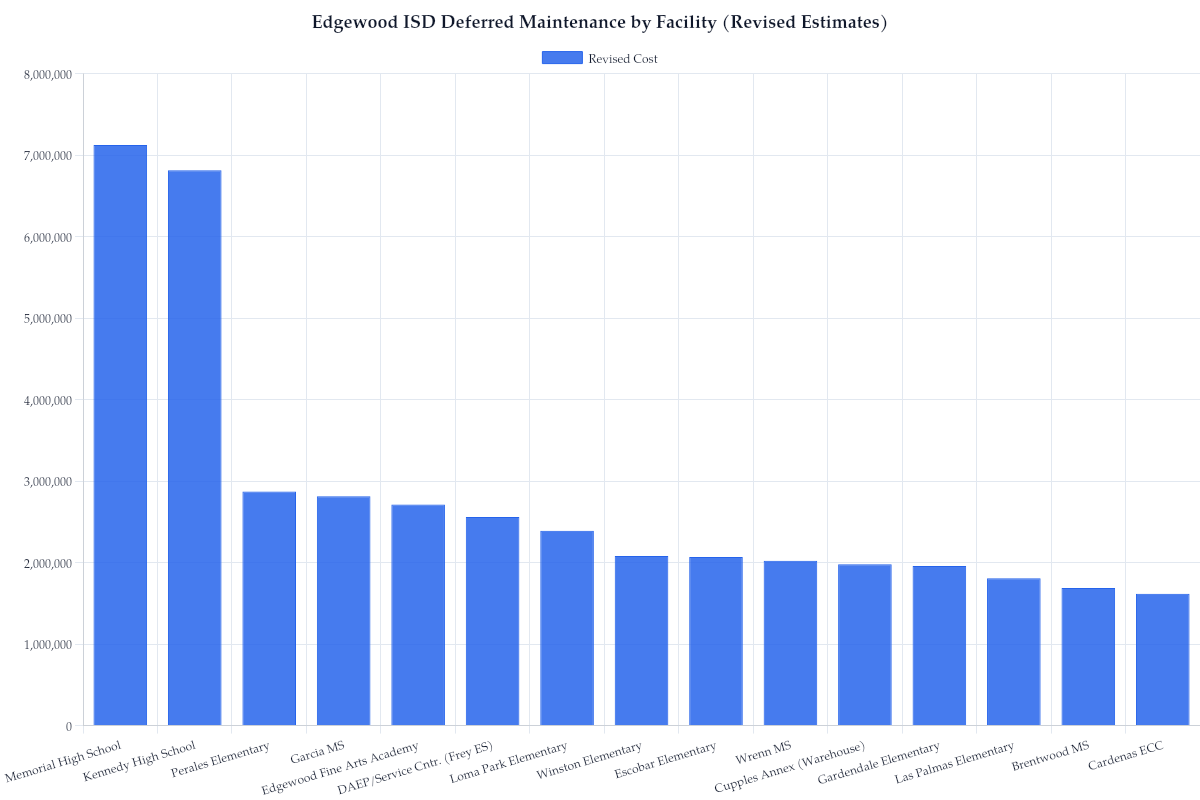
Edgewood ISD's Facility Condition Assessment catalogs $113.3 million in deferred maintenance across 33 facilities (Edgewood ISD, 2026). Memorial High School carries $7.1 million in deferred maintenance costs, while Kennedy High School carries $6.8 million. The 1986 Accountable Costs Advisory Committee recommended equalized state construction funding. Forty years later, the district that sued for equitable funding in Edgewood v. Kirby (1989) maintains millions in deferred repairs while operating 8 SB 1882 partnership campuses, outsourcing instruction at more than a quarter of its 29 campuses (Edgewood ISD, 2026).
5.5 Policy Recommendations
The eight recommendations below address the structural failures documented in Sections 4A through 4E.
First, the 90th Legislature should commission an updated Accountable Costs study using ARC's regression methodology or an equivalent approach to derive empirically grounded compensatory and bilingual education weights from current PEIMS data. No Accountable Costs study has been conducted since 1988, despite the statutory mandate for biennial review under TEC Sections 16.201-16.203. The Morath Court described the frozen weights as evidence of an "ossified" system. An updated study would address the court's warning directly. Funding weights should be recalibrated on a regular cycle, at minimum every five years, with grade-level differentiation derived from the three-bucket ARC model (elementary, middle, high school) and additional weights for chronic absenteeism, homelessness, and foster-care status that TEC §48.104 currently does not recognize.
Second, the Legislature should index the Instructional Facilities Allotment guaranteed yield ($35 per ADA per penny, frozen since 1999) and the Existing Debt Allotment guaranteed yield ($40 per ADA per penny, last adjusted 2017) to construction-cost inflation. The 1986 Accountable Costs Advisory Committee recommended that the state assume direct responsibility for equalized construction funding. The Legislature created IFA and EDA instead. The frozen guaranteed yields have produced facility-funding access disparities that the bond election mechanism amplifies rather than corrects.
Third, the Legislature should establish a state Facility Equalization Allotment that provides matching aid for ISD bond-funded construction at districts with taxable property wealth below a per-pupil threshold (e.g., $300,000 per WADA). Texas is one of a handful of states without direct state funding for school facility construction. The mechanism reaches the wealth-disparity case where districts pass bonds but local property wealth cannot fully fund the required construction.
Fourth, the Legislature should establish a Bond-Failed Fast-Growth Allotment that provides state per-pupil facilities aid for districts that meet two conditions: TEA fast-growth designation, and at least one failed bond election within the preceding five years. Cleveland ISD failed four of five bond elections 2019-2023 while serving 92.8% economically disadvantaged students and growing 40.8% in enrollment. Statewide, 738 bond propositions failed since 2016. The trigger-allotment preserves local bond authority while ensuring that systematic local rejection in a growing district does not foreclose the state's Article VII §1 obligation to maintain a structurally sound system.
Fifth, the Legislature should restructure the Senate Bill 1882 partnership program codified in TEC §11.174. The reform requires public posting of all proposed performance contracts with no less than 60 days' public comment before approval, operator-pool transparency including TEA's complete approval rubric and the list of operators TEA has rejected with stated reasons, a sunset clause terminating performance contracts automatically after three years unless renewed by elected board vote rather than TEA fiat, a bar on partnerships at campuses where the operator's principals or their immediate family hold financial interests in the district's vendors or related entities, and a clawback provision recovering excess state funding from operators who underperform their contract goals.
Sixth, charter expansion under 19 Texas Administrative Code §100.1035 should require an Independent School District impact assessment before TEA approves new charter campuses in existing service areas, and the Legislature should prohibit simultaneous service on Independent School District and open-enrollment charter governing boards in overlapping service areas. The current §100.1035 evaluates only the charter applicant's own performance. It contains no requirement to analyze the fiscal, enrollment, or facilities impact on the ISDs whose service areas the charter will enter. Together these reforms close the regulatory gap that allowed 118 non-HISD campuses operated by 51 different Local Education Agencies to be authorized inside Houston ISD's boundary.
Seventh, the Legislature should restructure the takeover trigger in TEC §39.107(a) to require de novo judicial review within 30 days of any takeover order issued by the Commissioner of Education. The reform places the burden of proof on the State to demonstrate that takeover is the least restrictive remedy available and requires the Commissioner to make written findings on the State's own contribution, through prior charter authorizations, prior accountability methodology decisions, and other state actions, to the conditions cited as the basis for takeover. Houston Independent School District's June 2023 takeover proceeded under the current framework and produced the manufactured-consent dynamic that subsequent Austin ISD partnership decisions replicated.
Eighth, the Teacher Incentive Allotment under TEC §48.112 should be amended to include a campus-type adjustment that distinguishes selective-enrollment campuses from comprehensive neighborhood schools, and to restrict TIA distribution by district need profile so that no district may receive more than 1.5 times its proportional share of TIA allotments, where proportional share is computed by district enrollment weighted by ARC student-need score. The Dallas Independent School District implemented the campus-type adjustment in the 2020-21 school year. The statewide TIA program does not include the correction. ARC quartile analysis shows that 46.1% of campuses in the highest economic-disadvantage quartile have zero TIA-designated teachers.
These recommendations operate together. Recommendation 1 addresses the frozen weights problem. Recommendations 2, 3, and 4 address the bond-dependent facility funding problem, with Recommendation 4 specifically addressing the structural failure mode where bonds repeatedly fail in growing districts. Recommendations 5 and 6 address the charter duplication and authorization problems. Recommendation 7 addresses the accountability-takeover dynamic. Recommendation 8 addresses the TIA pipeline. None of the recommendations is sufficient alone. Together they remediate the structural soundness shortfalls documented in Sections 4A through 4E.
5.6 The 90th Legislature
The 90th Texas Legislature convenes in January 2027. The Morath Court's warning that the system was "ossified" and "ill-suited for 21st century Texas" will be a decade old. Since the 2016 ruling, charter enrollment has grown while ISDs in every major metropolitan area have contracted. Seven hundred thirty-eight bond propositions have failed statewide. The compensatory weight remains unchanged since 1984 at 0.20. Dallas, Houston, and Fort Worth ISDs have undergone state takeover or PAC-funded governance changes followed by deployment of the same compensation model. A third parallel funding system, school vouchers under TEFA, was enacted in 2025, opening new pathways of constitutional inefficiencies that should be challenged.
The ARC framework offers the 90th Legislature a measurement tool grounded in TEC Section 29.081, calculated from PEIMS data, and calibrated to current student populations. The $1.82 billion funding gap quantifies the cost of 40 years of frozen weights. Article VII, Section 1 still requires an "efficient system of public free schools." The Edgewood line of cases still requires substantially equal access to funding at similar levels of tax effort. The Morath court still requires structural soundness. The 90th Legislature has the data infrastructure to build a funding system calibrated to the students Texas actually serves.
Edgewood ISD Deferred Maintenance by Facility (Revised Estimates)